Story 1 of 7
Why the Great Trek Began
Why thousands of farming families left the British-ruled Cape Colony in the 1830s.
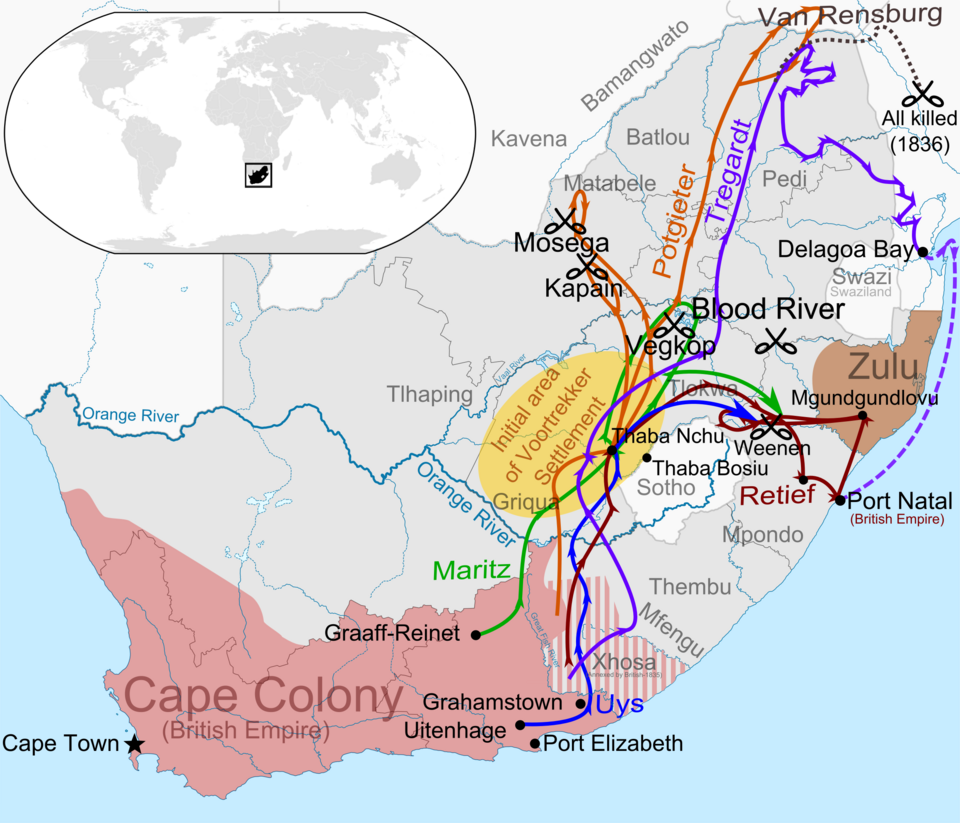
In the mid-1830s, long lines of canvas-covered ox wagons began rolling north and east out of the Cape Colony, at the southern tip of Africa. Over roughly a decade, somewhere between 12,000 and 15,000 Dutch-speaking settlers left their farms and towns for the interior. Afrikaners call this movement die Groot Trek, the Great Trek. Those who took part became known as Voortrekkers, “those who go ahead,” or pioneers. Americans may think of the wagon trains on the Oregon Trail, which began a few years later. The comparison is imperfect, but it captures the scale: whole families, with their cattle, servants, Bibles and guns, heading into land they did not know.
A colony changes hands
The Cape had been run by the Dutch East India Company since 1652. Its European settlers, a mix of Dutch, German and French Huguenot origin, slowly developed their own language, which became Afrikaans. On the frontier lived the trekboers, stock farmers who moved with their herds across vast, thinly governed land. They were independent by habit and suspicious of any distant authority.
Britain occupied the Cape in 1795, handed it back briefly, and took it again in 1806; the transfer was made permanent in 1814. British rule brought new ways of doing things. English became the language of government and the courts during the 1820s. In 1820 about 4,000 British settlers arrived in the Eastern Cape. Officials, missionaries and newspapers in London increasingly shaped policy on the frontier, often with little understanding of frontier life as the farmers saw it.
The grievances
Historians usually point to several overlapping causes.
Security on the frontier. The Eastern Cape frontier saw repeated wars between colonists and the Xhosa. In the Sixth Frontier War (1834–35) farms were burned and livestock lost. Governor D’Urban annexed land as a buffer, but in 1836 the Colonial Secretary, Lord Glenelg, reversed the annexation and blamed the colonists for the war. To many farmers it seemed that the government would neither protect them nor let them protect themselves.
Land. Good farmland in the colony was running out, and young families could not get farms of their own. Reports from scouting parties, the so-called kommissietrekke (commission treks) of 1834, described rich, well-watered land in Natal and the highveld.
Self-government. Above all, many wanted to govern themselves, in their own language and by their own church. In February 1837 Piet Retief published a manifesto in the Graham’s Town Journal explaining why they were leaving. He complained of losses through emancipation, of frontier insecurity and of the “unjustifiable odium” cast on them by missionaries. He promised the trekkers would not enslave anyone, and that they would leave in peace and live in peace with their neighbors.
Leaving
The Trek was not one journey but many. Separate parties left under their own leaders from 1835 onward, with the main wave in 1836–1838. They travelled in ox wagons pulled by teams of about 14–16 oxen, covering a few miles a day. At night or under threat they drew the wagons into a laager, a defensive ring. The men were organized for war into a commando (Afrikaans kommando), a mounted citizen militia that elected its own officers.
It is also worth remembering that the Voortrekkers did not travel alone. Khoikhoi workers, formerly enslaved people and other servants and agterryers (mounted attendants) travelled with them, and their story is part of the Trek as well.
The interior they entered was not empty. It was home to the Sotho, Tswana, Ndebele, Zulu and other peoples, some of whom had been shaken by decades of war and upheaval. The meeting of these worlds would decide the history of South Africa for the next century and a half.
Sources
- South African History Online, “The Great Trek 1835–1846”: sahistory.org.za
- Hermann Giliomee, The Afrikaners: Biography of a People (2003)
- Piet Retief’s Manifesto, Graham’s Town Journal, 2 February 1837
- Eric Walker, The Great Trek (1934)